热烈庆祝Amtrak成立50周年
热烈庆祝Amtrak成立50周年
与未来同行
Amtrak自1971年以来成为美国国铁,它通达全国,让朋友与亲人纵然相隔两地也能相聚。值此50周年之际,欢迎您与我们共同回顾过去、展望未来。
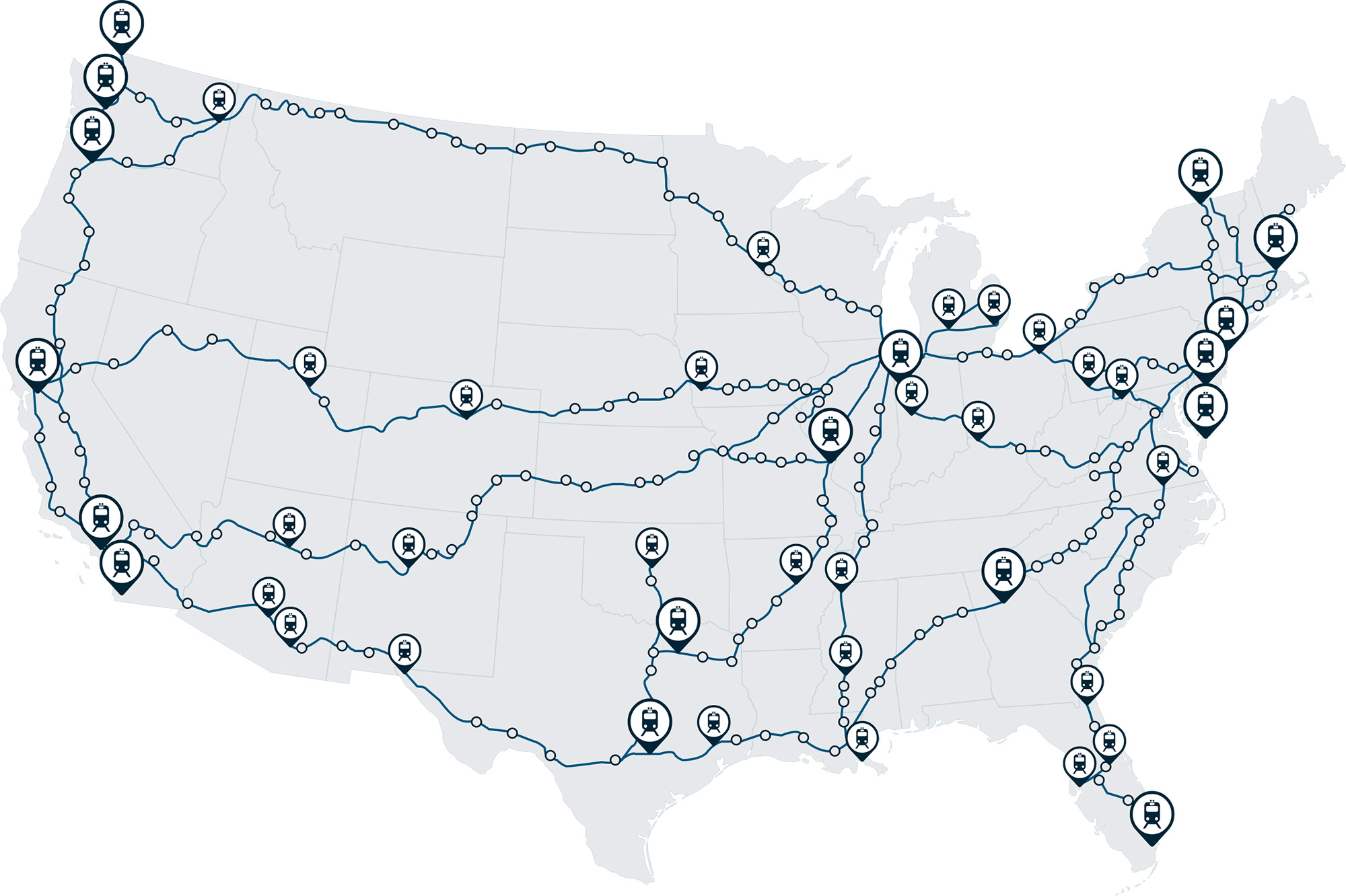
1971年5月1日,当Amtrak的第一列列车从New York City驶往Philadelphia时,没有人能够想象到未来的情况。如今,我们拥有超过17,000名敬业的员工以及跨越46个州、Columbia特区和3个加拿大省,连接超过500个目的地,路线总长21,400英里的国内交通运输系统。
我们持续投资以不断改善客户体验。未来可期。Amtrak对铁路的未来有着远大愿景,通过投入新设备、改造铁路车站、实施重大键铁路基础设施现代化、充分运用新技术、对抗气候变化、扩展服务,提高美国民众的出行便利性。
50周年,我们才刚刚起步。
未来,与我们一路同行。
Amtrak: 50年的业界领先企业
50年来,Amtrak一直为全美各地、各种规模的社区提供客运铁路服务。请通过数据了解我们五十年来在创新、安全、服务、可持续发展以及社区方面的投入。另外,还有我们对21世纪安全、可靠和最先进的铁路服务的承诺,和以为了履行该承诺而开展的相关工作。
1970年代
Amtrak开创了美国铁路客运服务的新纪元。
1980年代
通过现代化和创新,开拓新路线,改善车站设施并加强安全防范措施。
1990年代
Amtrak投资启用新设备,实现铁路安全升级,并为全美各地带来工作岗位。
2000年代
Amtrak在支持21世纪美国交通基础设施方面发挥了关键作用。
2010年代
Amtrak通过投资可持续技术与新设备,践行低碳环保,持续引领绿色出行新风尚。
2020年代
Amtrak不断引领安全创新,倡导可持续性发展,帮助旅客探索美国铁路旅行的无尽乐趣。
50周年庆祝活动,Philadelphia, PA
观看我们从2021年4月30日开始的庆祝活动,回顾美国铁路的50年历程,展望客运铁路的美好未来。与未来同行,从敬业的员工到忠实的乘客。
显示/隐藏文字稿
[Sound: rhythmic train wheels clacking along tracks, low mechanical rumble]
Conductor: All aboard!
On screen text: The Future Rides with Us
Narrator: There was an era when the other side of the country might as well have been the other side of the world. That's the way it stayed until brave and brilliant pioneers built railroads to open new opportunities and bring a sprawling nation closer together. Passenger trains remained central to America's story until the mid-20th century, when the reliable locomotive fell on hard times. While private railroads teetered on the brink of failure, a bold Congress, hearing widespread public support, stepped in to fund a unified passenger rail system to keep America on track: Amtrak.
[Music: uplifting orchestral swell]
Narrator: It wouldn't be easy, but visionary women and men worked tirelessly to consolidate operations from 20 different rail companies and assemble a network to link small towns and big cities from coast to coast. The plan worked, but they didn't stop there. They got busy renewing our fleet, investing in upgraded track, refurbishing stations, expanding service with state partners, and bringing high-speed rail to America. Their forward-looking dedication and constant drive for improvement paid off with renewed public interest in rail travel, steadily growing ridership, and a rich 50-year legacy of unbelievable journeys. Now, a new generation looks ahead to the next 50 years. They're unveiling state-of-the-art facilities, crafting innovative initiatives, and rolling out a cutting-edge fleet of high-speed train sets and efficient locomotives to ensure rail's place in the future as a cornerstone of clean transportation. They're exploring access to new communities, so no one's left behind, and implementing enhanced safety standards for peace of mind during today's travel and whatever lies ahead. At the heart of Amtrak, there's always been great people—people who believe in the power of staying connected to faraway places, to our history, to what's next, and to each other. 这,就是为什么,未来与我们一路同行。
Bill Flynn: Good afternoon. I’m Bill Flynn, CEO of Amtrak, and joining me here today are our Amtrak Chairman of the Board, Mr. Tony Coscia, Board Director Mr. Bert DiClemente, and several other members of our senior management team, and we welcome you here to our 50th anniversary celebration. On May 1st, 1971, the first Amtrak train rolled out of New York City on route to Philadelphia, where we're gathered here today, and certainly at that time no one could have imagined what would lay ahead. And today, we're here representing our more than eighteen thousand dedicated employees. They operate a national system serving over more than five hundred destinations across forty-six states, the District of Columbia, and three Canadian provinces. And we have tens of millions of loyal Amtrak customers, and I'm honored to be joined here today by perhaps one of Amtrak's most loyal customers, the 46th President of the United States, Joe Biden. Mr. President, I thank you for being here to mark this milestone with us and for your tremendous support of Amtrak throughout your career of serving our nation. The American Jobs Plan, which includes 80 billion dollars for rail, is just what the country needs as we build for the future. America needs a rail network that offers frequent, reliable, sustainable, and equitable train service. Amtrak has the vision and the expertise to deliver it. Now, we need Congress to provide the funding for the next 50 years. Our vision includes expanding rail service to connect to up to 160 new communities throughout the United States, and by building new and improved corridors in over 25 states. As part of this comprehensive plan, Amtrak will introduce new stations in over half of the United States, increase rail service to 47 of our top 50 metropolitan areas, and create over half a million new jobs—new, well-paying jobs. But we're not stopping there. We're investing in our fleet. Last week, we announced the procurement of 83 intercity train sets which will operate on the Northeast Corridor and various state-supported and long-distance routes, and we will soon debut the new high-speed Acela train sets, setting the stage for the next generation of train travel in America and on our Northeast Corridor. We're investing in our stations, in January, our partnership with the state of New York—we, with our partnership with the state of New York, we opened Moynihan Train Hall, Amtrak's new home in New York City, a world-class station providing an enhanced customer experience. And we are advancing station modernization projects in other major cities: Chicago, Washington D.C., Baltimore, and right here in Philadelphia. We're investing in our infrastructure. We are making important strides on vital infrastructure projects up and down the Northeast Corridor, projects such as our Gateway Program and the rebuilding and replacement of the Baltimore Potomac Tunnel. Planned infrastructure projects will increase track capacity, improve ride quality, and offer greater reliability. All of these projects are investments in our future, but they're also investments in our planet. Amtrak provides a more sustainable mode of travel, and demand for rail travel will continue to grow. In fact, traveling on Amtrak emits up to 83 percent fewer greenhouse gas emissions than by driving and up to 73 percent fewer GHGs than by flying. We have a truly dedicated workforce in Amtrak that carries on the legacy of the railroaders who served before them and who take great pride in connecting America. And it's because of our employees that Amtrak serves a vital role in our country's mobility strategy. We continue to see their important contributions play out in real time as we navigate through the COVID-19 pandemic. When the world stopped in many ways due to the spread of the coronavirus, our employees—really, indeed, all transportation employees—made sure America kept moving. They were on the front lines every day, providing the essential transportation services to those who needed it. And now more than ever, Amtrak is ready to provide the safe journey that travelers are seeking as our nation recovers from the effects of this pandemic. It's been an honor to lead Amtrak during this critical time. I come from a railroad family like so many other fellow Amtrak colleagues do. My father and uncle were both locomotive engineers. My brother David was an Amtrak conductor and local union chair with over 40 years of service, and my brother Brian works at Amtrak now with over 15 years of service to the company. These connections deepen my pride in Amtrak and my commitment to further Amtrak's important mission to serve our country. We have much to celebrate today and more to look forward to in the future. In closing, I'd like to thank those who paved the way. We owe you a tremendous debt of gratitude. I salute the men and women who make up Amtrak's workforce, our partners, political leaders on both sides of the aisle, and our many stakeholders whose tireless efforts keep our railroad running. And of course, to our customers: thank you for your continued support. Get ready, America. While Amtrak may be turning 50, we're just getting started. And now, it's my pleasure to welcome to the podium Mr. Blake Weaver, who's an Amtrak conductor here in Philadelphia, who will introduce the President. Thank you, Blake.
Blake Weaver: Thank you, Mr. Flynn. I, too, am part of a railroad—sorry, I, too, am part of a railroad family. My father was a conductor for over 40 years, and I’ve been one for the last 18. I joined Amtrak on Presidents' Day in 2004 as assistant conductor, and after a couple years, I was promoted to a conductor. I can honestly say I love what I do. I like having the opportunity of working with my co-workers to serve Amtrak's customers up and down the Northeast Corridor to get them safely and on time to where they're going. I'm proud of Amtrak’s mission and especially proud of how hard they worked during this pandemic and keeping essential passengers across America moving. I’m also excited to see the rest of our passengers back on our trains. I’m very excited to see them on our brand-new Acela Express sets. One of my first lessons my father taught me as a conductor was to look out for one of Amtrak's most frequent riders, Senator Joe Biden. In 2006, I had the—I had the privilege of meeting Mr. Biden on the train while collecting tickets. Before I had a chance to introduce myself, Mr. Biden stopped what he was working on, invited me to sit down, and talk to him for a few minutes. I always remembered how he treated everyone. He always made time for both the passengers and the employees. He also treated everyone like they were family. So, Mr. President, I'd like to thank you for all the support you have given Amtrak. I'd like to thank you for all the miles you added up over the years. I'd like to thank you for being part of the Amtrak family. I would like to thank you for being part of my family. Ladies and gentlemen, I'm proud to introduce the President of the United States of America, Mr. Joe Biden.
Joe Biden: Hello, everyone. Great to be back in Philly. Great to be back to 30th Street Station. Blake, you didn't—uh, you didn't treat each other just like family, you are family. Please sit down, guys. Sit down. Your dad, Greg, is here too. As far as I'm concerned, the Weavers are family. And Justin Gray, speaking of family, your father and I fought a lot of fights together, planned a lot of those fights on Amtrak coming back to Philly. I didn't come all the way to Philly—it's a wonderful tribute to the—to this station to bear his name. And, uh, Bill Flynn, thank you for having me. Governor Wolf, Mayor Kenney, Congressman Evans, thank you for the passport into the city. Appreciate it. And we have another—I don't know if they're all here still, but I met a lot of important friends that were here to—uh, for this occasion. I understand Senator Blumenthal is here. Right there, you go—one of the great senators. The former attorney general took care of my son, Beau, when he was attorney general. Thank you very much. And also Dwight Evans. Dwight's here. You can't miss Dwight. Come on, Dwight, stand up there, man. And, uh, a good friend of mine and worked like the devil to get me elected, Brendan Boyle. Brendan, that's the Irish of it, man. And Donald Payne, New Jersey. I keep telling Donald, because Delaware's so small, it is a constitutional—there was a case in the Supreme Court. Delaware, the state of, owns the Delaware River up to the high watermark in New Jersey. Just want you to know that you got to treat us with more respect. And, uh, Mayor Kenney, thanks for the passport, great friend. Thank you, Mr. Mayor, you're doing a heck of a job. And, uh, a real close, close friend who was a co-chairman of my campaign and just a great friend is our whole-time Governor, Ed Rendell. Eddie, thank you, pal. This city owes you a lot. And Tony Coscia, the chair of—the chairman of the board. And one of my best friends in life, a guy named Bertie DiClemente. We've known each other from high school; we went to rival high schools. Bert ran my operation in Delaware for years and years. The one election I got the most votes in was the last election I ran for the Senate. I was also running for Vice President at the time because, under Delaware law, if you're not out of the Senate race in a certain time period, you got to stay in. And so Bert ran—he was the Senator in Delaware campaigning for me. He got more votes than I got. So, Bert, thank you very much. Also Justin Gray—I've mentioned Justin already and his dad—uh, and Greg Weaver, Jr. Greg, you're—you are family. Uh, I mean—excuse me—Blake and his family, and married Kate. What a lovely kid. And Bill Flynn of Amtrak. You know folks, uh, the fact is that, uh, if I have in the past when I've ended up at the 30th Street Station, Amtrak station, it's probably because I took the late train back from Washington and I slept through the Delaware stop. Literally. Not figurative—I only did it about four times. But, uh, but I would have—I wouldn't have missed this for the world. It's an honor to celebrate Amtrak's 50th anniversary. I look forward to a bright future for all American rail. You know, back in 2016, uh, I announced a federal loan that allowed Amtrak to purchase the new Acela train sets, as you see behind me. And they look great; I can hardly wait to ride. And they're made—and they're made in America, and I wanted to see more of that. That's why the investments in my American Jobs Plan are guided by one principle: buy American. Buy products that were made in America. American tax dollars are going to be used to buy American products to create American jobs. When I became Vice President, one of, uh, the Capitol Hill newspapers estimated that I had taken more than 7,000 round trips on Amtrak over my career. I think that's an exaggeration, and I'm going to rely on those two conductors. And that Mr. Weaver remembers one of which, a guy named Angelo Negri. And Angelo—there was an article my, I guess, my fourth or fifth year as Vice President saying, "Biden travels 1,300,000 miles on Air Force One." And I used—the Secret Service didn't like it, but I used to like to take the train home. My mom was sick, and I'd come—try to come home almost every weekend as Vice President to see her. And I was getting on the train, and Angelo Negri came up and he goes, "Joey, baby!" and he grabbed my cheek, started to squeeze it like he always did. And I thought he was going to get shot, and I'm serious. And I said, "No, no, he's a friend." He said, "Joey, what's the big deal? 1,200,000, 300,000 miles on Air Force Two? You know how many miles you traveled on Amtrak?" I said, "No, Angel, I don't know." And he gave me the calculation, and he said, "You traveled 1,515,000 miles on Amtrak." So, the fact is, I probably take Angelo’s word before I took the word of what the article said. But the point is, in the process, as, uh, Conductor Weaver will tell you, Amtrak became my family. I literally—literally every single day that I was in the United States Senate, I caught the—the—the either the 7:28 (it became the 7:32) and—or—and got home on—if I got lucky, I got the Metroliner that left—the last one left at six. I got the 7:30 coming home. And you get to know everybody. You get to know the folks. And I used to have a—a Christmas party for Amtrak employees at my home that got so big, we ended up having a summer party because family and retirees kept coming back. I want to tell you, these guys and women—they work like the devil. They really, really, really do. And Amtrak wasn't just a way of getting home; it provided me—and I’m not joking—an entire other family. A community dedicated, that was professional, and that we've shared milestones in my life. And, uh, I’ve been allowed to share milestones in theirs. I’ve been to an awful lot of weddings, and christenings, and unfortunately, some burials as well. We're family. You know, I—I remember one night my daughter was only six years old and it was my birthday. And, uh, we were voting. I went to Bob Dole and I said, "Bob, when's the next vote going to take place?" He said, "Joe, what? Why?" I said, "Well, my daughter is really upset I’m not going to be able to be home for the birthday cake she made for me." He said, "What do you need?" I said, "I need just time to catch the five o'clock Metro, and I can get the 6:28 coming back." Because on the platform—yes, in Delaware, you walk from one side to the other—got off the train, my wife Jill was standing there, my daughter had the cake, the candle lit, I blew them out, gave me a kiss, walked across, and got on the southbound. So, it has been part of my life. I’ve been riding on Amtrak for almost as long as there's been an Amtrak.
I've come to see that Amtrak doesn't just carry us from one place to another; it opens up enormous possibilities. And especially now, it makes it possible to build an economy of the future and one that we need. Last week, I announced the target of cutting greenhouse gases and gas emissions in half by 2030, and most of that-of those emissions in this-in this county, in this country-come from transportation. But if just 10 percent of the freight shipped in the largest trucks went by rail instead, we'd be removing 3,300,000 cars from the road. And we'd be planting-it's the same as doing that or planting 260,000,000 trees in America. As I've said from the beginning, when I think about fighting climate change, I think about jobs. And rail-and hopefully the expansion of rail-provides good union jobs, good-paying jobs. It also connects people to jobs and economic opportunities that can be reached from wherever you live. Let's put this in perspective. For years, I fought efforts to cut funding for Amtrak, because cutting funding for Amtrak would be a disaster for our environment and our economy. Amtrak carries four times as many riders between Washington and New York City as every single airline does. Within 50 miles of the shore, from Florida all the way up the coast-imagine what we'd have to do a single day without the Northeast Corridor. For example, a day without Amtrak and the Northeast Corridor would cost the economy 100 million dollars. If you shut down all passenger service on Amtrak's Northeast Corridor, the projects that compensate for the loss-you'd have to add seven new lanes of highway on I-95. And consider that cost: an average of 30 million dollars for a linear mile on I-95. This is the bargain of bargains and bargains. It's economical, and it's environmentally a lifesaver.That's why in my rescue plan-American Rescue Plan-we worked hard to keep Amtrak running at the heights of the pandemic. Because we weren't traveling, Amtrak furloughed 1,200 employees, and we were able to provide emergency relief to keep rail service running. And we've now brought back 1,200 union workers who had been furloughed. And by the way, you get a union wage, not 15 bucks an hour-every prevailing wage. But we have to do more than just build back. We have to build back better. And today, we have a once-in-a-generation opportunity to position Amtrak, and rail, and intercity rail as well in general, to play a central role in our transformation of transportation economic future to make investments that can help America get back on track-no pun intended. Before the pandemic hit, Amtrak's ridership and revenues were on the upswing. The Northeast Corridor has been making money for a long while now, but last year, the whole of the Amtrak system was projected to break even for the first time in history. But then we had the pandemic. But there is still a huge backlog and deferred maintenance-huge need to modernize our trains, our stations, our bridges, our tunnels. Well, we're taking-we're talking about critical jobs like the Hudson River Tunnel, the Baltimore Potomac Tunnels, and the Susquehanna River Bridge. In my American Jobs Plan, I propose spending 10 billion a year on passenger rail and freight rail. Of this, two-thirds would support existing Amtrak routes, including the Northeast Corridor, but nationwide. And we're talking about union jobs, as I said, and we tried-we're taking care of the riders, laying track, wiring switches, fixing bridges, tunnels, modernizing stations, and repairing and rebuilding this vital infrastructure. This would allow for the potential to expand passenger rail service. Imagine a two-hour train ride between Atlanta and Charlotte going to speeds of 220 miles an hour, and a two-and-a-half-hour trip between Chicago and Detroit, or faster and more regular trips between Los Angeles and Las Vegas-a route that I imagine could be pretty popular on Fridays. Bill, as you've said, your vision for Amtrak calls for a new intercity rail service, up to 160 previously unserved communities being connected. Think of what it will mean for opportunity if we can connect Milwaukee to Green Bay to Madison, Scranton and Allentown to New York, Indianapolis to Louisville, and much, much more. It's going to provide jobs; it will also accommodate jobs. And what this means is that towns and cities that have been in danger of being left out and left behind will be back in the game. It means families don't have to sacrifice the cost of living or quality of access to opportunity that sometimes only occurs if they live in a big city. We have a huge opportunity here to provide fast, safe, reliable, clean transportation in this country. And transit is part of the infrastructure, and like the rest of our infrastructure, we're way behind the rest of the world right now. We need to remember we're in competition with the rest of the world. People come here and set up businesses, people stay here, people grow because of the ability to access-access transportation, access all the infrastructure. It's what allows us to compete and, with the rest of the world, to win the 21st century. We've got to move. China already has 23,000 miles of high-speed rail. 220 miles per hour. Two-thirds of all the high-speed rail in the world. 220 miles an hour. And they way, and they're working on, uh, transit on trains that can go as high as 400 miles an hour. We're behind the curve, but folks, as I said the other night: America is on the move again. We need to remember that; we're in the United States of America. There's nothing beyond our capacity. Nothing we can't do if we do it together. As we celebrate Amtrak's birthday, I was thinking about America. Amtrak's role, as I said, on my birthday when they allowed me to come home and blow out that candle... there's a lot of things that Amtrak does. And you know, the fact of the matter is, if we were able to-which is now beyond the ability to pay for it-but if we're able to straighten out three curves from Washington to New York, you could make it from Washington to New York in an hour and 32 minutes. An hour and 32 minutes, folks. There's so much we can do, and it has such a incredibly positive impact on the environment, incredibly positive impact on work, President-on-on opportunities. And again, all the things we have to do to put Amtrak in place and be one of the great, great contributors to our country is we have to invest. And so, you know, if you think about it, when we were-when I was Vice President with Barack, he allowed me to put together a budget for Amtrak. And it had money for high-speed rail at 200 miles an hour from-from, uh, uh-excuse me from Charlotte, one another line going from, in Florida, down to Tampa. Another line-if we had moved, we'd have that tunnel fixed in New York now. The money was there to get it done. There's so much we can do, and it's the biggest bang for the buck we can expend. So, on this momentous birthday of Amtrak, I want to-I want to thank you for making so many birthdays possible. I believe that the best days for Amtrak, and for rail, and for America are ahead. I really believe that. And I'm just confident. I'm confident we can get this done. And I must tell you, I'm anxious to see the new train. Thank you all so very much. God bless America. May God protect our troops. Thank you, thank you, thank you.
[Music Playing]
Richard Anderson: Congratulations, Amtrak, on the 50th anniversary of your founding.
Kenney Etherton: From one transportation agency to another, congratulations.
Jitendra S. Tomar: Congratulations once again. Keep it up. Thank you.
Senator Patrick Leahy: I want to congratulate Amtrak for being an invaluable resource for Vermonters, actually for all Americans.
Paul Reistrup: I am Paul Reistrup, second president of Amtrak, wishing to congratulate everyone involved in Amtrak's 50 years.
James Souby: Happy 50th anniversary, Amtrak.
Kevin S. Corbett: Who would have guessed when Tony Coscia and I were students at Georgetown some 40 years ago, riding Amtrak between New Jersey and D.C., we would be here celebrating the 50th anniversary in our current positions?
Jim Mathews: For the past decade, we've seen record ridership year after year after year, and people across America clamoring to bring trains to their communities.
Wayne E. Davis: Before the Acela trains were created, we were fortunate to have been included in the test trials of Sweden's X-2000. Next was the ICE Train from Germany, which was being tested in the corridor. The unveiling of the Acela was the most exciting event ever held to celebrate Amtrak’s entry into high-speed trains, and held in a New York theater for all Amtrak employees and TrainRiders Northeast as well.
Anne Canby: Amtrak means “passenger rail.” And living in Wilmington, Delaware, passenger rail is critical for our state's economy.
Dowling Watford: We're very fortunate here in Okeechobee to have an Amtrak stop here. It's a great asset for our community. It really helps our citizens when they need to travel, and it helps our visitors that are able to come to visit us here in Okeechobee.
Chuck Riecks: Amtrak trains like the Cardinal are vital for the continued economic health of the state of West Virginia.
Mark Bryant and Bob Bryant: Rail is the most efficient way—most environmentally efficient way—to move people from one place to another. Second, I think of how much it reduces congestion on our highways, and third, I think of how enjoyable and relaxing it is to ride the rails.
Donna McLean: I remember my favorite trip was with my family, and we rode the Empire Builder to Glacier National Park. And it reminded me during that trip that, you know, there's this long history of passenger rail service taking people to our national parks.
Lucy Vinis: I have a lifelong affection for train travel. I grew up in suburban New York where the Hudson Division was a lifeline to New York City. Riding that train was my first independent travel experience as a girl.
Leslie Richards: One of my best memories this past year was teaming up with Amtrak for the "Sound the Horn" effort to honor heroic transportation and other essential workers across the United States. This past year proved transportation workers are true heroes.
Richard Dalton: When I think of Amtrak, the first word that comes to mind is partner. There is no doubt our commuter rail service would never have grown to the extent it has without Amtrak's support.
Kevin S. Corbett: Working with Amtrak, we've achieved what few thought possible back in 2018: the successful certification of our Positive Train Control project. All these projects will do much more than improve service and reliability for our customers; it will create jobs and economic activity throughout our region, helping to spur our economy.
Tony Marchiando: AAPRCO and our car owner members have had a good relationship with Amtrak during its 50 years, and we look forward to this continuum.
Richard Anderson: Amtrak is a national asset. It is the only national railroad—passenger railroad—in America.
Peter DeFazio: Amtrak needs investment, and the Biden plan—80 billion dollars for rail—is the beginning of a new future for Amtrak and rail in the United States of America.
Jack Reed: Well, Amtrak is a very valuable part of the United States transportation system because it moves people from city to city, from country to city. It is efficient; it is effective.
Roger Wicker: By providing federal, state, and local support, we can help Amtrak revitalize passenger rail service across America.
Wick Moorman: I think the country has evolved and sees more and more of the need for rail passenger transportation in terms of climate, in terms of mobility.
Michael Cahill: It's very clear to me that Amtrak is a key part of our climate change story. I think we're—we're on the edge of redefining transportation, long-distance and short-distance transportation, and Amtrak plays a key role in that.
Lucy Vinis: Train travel is one key in our response to climate change. I look forward to having more trains more often that can reduce the need for cars on I-5 and carry us swiftly and safely up and down the West Coast.
Tony Coscia: Good afternoon. I'm Tony Coscia, Amtrak's Board Chairman. It's great to be here celebrating Amtrak’s 50th anniversary. I join you from Moynihan Train Hall, Amtrak's new home in New York City. We opened this great building earlier this year as a fitting start to a new era for Amtrak and the nation. It has been a great honor to serve as Amtrak’s Board Chairman. I'm proud of the many accomplishments that have been achieved: from improving financial performance, record investment in rolling stock, technology, and stations, and broad enhancements to customer service and, most importantly, safety. But most of all, I'm proud of Amtrak's employees. From our management team to the world-class railroaders throughout our network, your dedication to delivering quality transportation to communities across the country is the reason why we are now presented with enormous opportunity. Amtrak is really a lot more than a railroad. It's not about trains; it's about people. Our 30 million passengers and 18,000 employees are the core of what defines Amtrak. Our mission is about more than just running trains from one place to another. If we do our job well, we help create economic opportunity and improve quality of life for those who use mobility as a way of building their future. We have a vision for the future that includes expanded service for dozens of cities and towns across America—a national network that connects people to jobs, families, and experiences; a network that offers safe, reliable, and sustainable mobility at affordable prices. We have earned the right to envision an exciting and transformational future. Projects like Gateway will allow Amtrak to play a key role improving our nation's ability to undertake generational projects, and we expect our next chapter to include setting the stage for true high-speed rail in the United States. We have seen a lot in the last 50 years, and Amtrak arrives at this point strong and committed to delivering on its promise to our passengers, employees, and the nation. Thank you. Now, join me as we hear from partners on their thoughts on Amtrak’s bright future.
On Screen text: The Future Rides with Us Celebration Event
John Robert Smith: I think Amtrak has a bright future in its connectivity—not just about high-speed rail, which is important—but about state-supported trains and long distance trains connecting a network across this country.
Tom Lazio: The future is bright and economical for cross-country travel with Amtrak, whom we're happy to be a part of this 50 year celebration. Thank you.
Senator Patrick Leahy: Amtrak has gone to great lengths to adapt its technology and operations to assure the health and safety of passengers and staff.
Leslie Richards: I'm most excited about partnering with Amtrak as we utilize the latest technologies to bring safe, reliable service to all of our rail customers.
Jim Mathews: The future for Amtrak is so bright. It's great to see Amtrak's leaders talking about serving 160 new cities and towns, adding more service in places that already have a stop, upgrading trains and service. And today there are more governors, and members of Congress, and senators, and mayors than ever before who support that vision.
Mike Inman: We're scheduled to get new passenger rail cars as part of an economic stimulus program. We're looking forward to that day, and all good things that come with being an Amtrak served community.
Phil Rico: Our commission is currently working—and diligently working—on increasing the service along the front range and look forward to continue seeing Amtrak traveling through Trinidad and on to other parts of the country.
Mark Bryant and Bob Bryant: We need a national passenger rail system, and here at the Buckingham branch, we hope that Amtrak will continue to flourish in the years ahead.
Keith Creel: It's exciting to see the potential that Amtrak has for rekindling America's love for train travel across this beautiful country of ours.
Wayne E. Davis: The recent news about the next generation of train sets currently under construction is a tangible sign that Amtrak intends to be a major player in providing modern, safe, efficient, and comfortable transportation.
Micahel Cahill: I'm standing here in front of locomotive number 300. It's the first of a series of new, long distance locomotives for Amtrak services all across the country. This locomotive is built for excellence and built with pride by hundreds of American workers here in Sacramento, California.
Henri Poupart-Lafarge: It was really an honor for us to have been chosen to introduce very high speed in the U.S., and I can tell you we are fully dedicated to this project. We are fully dedicated to—to deliver this trend on time with the right quality, the right service, and also fully made in the U.S.
Chuck Schumer: And over the next year, I look forward to working with you to finally advance the critical Gateway Tunnel project. It is gonna happen; we are gonna make sure. And launch the newest Acela fleet being built right now in the great city of Hornell, New York.
Jim Mathews: Amtrak's about a lot more than trains. Amtrak connects people: students to universities, grandparents to grandkids.
John Robert Smith: People to education, people to opportunity. Acela certainly does that behind me here in Washington, DC. The long-distance system does it across America.
Clarelle DeGraffe: Amtrak is a symbol of bringing people together from the East Coast, the West Coast, and everywhere in between. 50 years of service connecting people in places meant overcoming the challenges of distance and turning destinations into journeys.
David Holt: That connection to the nation's train network means so much to us, and we have fought through the years to maintain it, and we have worked to restore that station as well.
David Price: Thanks to you, millions of Americans travel to work, to see family, to explore what the United States has to offer.
Lance Fritz: You know, Amtrak’s a way for riders to be able to experience our urban environments and our vast expanse of the United States in a way that you just can't almost any way else.
Roger Wicker: Amtrak connects population centers with tourist destinations, workers with jobs, and places like my home state of Mississippi with the rest of America.
Clarelle DeGraffe: I'm excited and look forward to continue working with Amtrak to service our region together as sister agencies and as customers make their safe return to our systems.
Qiana Spain: Good afternoon. I am Qiana Spain, Chief Human Resources Officer at Amtrak. I am pleased to be joining you today from our nation's capital. Amtrak’s anniversary marks an extraordinary milestone, especially considering there were many in 1971 who thought Amtrak wouldn't make it to our fifth anniversary. But what those in 1971 didn't know is something that I have learned in my short time at Amtrak: the secret to our success is our people and our partners. We have an incredible workforce that is dedicated to our mission. Their efforts are enhanced by truly great partners at the local, state, and federal level who recognize the benefits of passenger rail to connect communities across America. It is this collaboration between our people and our partners that have made Amtrak the success it is today. Over the last five decades, by working together, we have been able to do extraordinary things like improve the reliability and safety of our infrastructure, modernize and enhance our stations, invest in new train equipment, and expand Amtrak service to more people and more places. We have a lot to be proud of, and our work is not done. Through continued partnership and working together, the best is yet to come and our future is bright. Please join me as we hear from our partners about what Amtrak employees mean to them. Thank you.
[音乐]
On Screen text: The Future Rides With Us Celebration Event
Donald Payne, Jr.: I want to congratulate all the workers who make Amtrak run as we celebrate its 50th anniversary.
Artie Maratea: Through thick and thin, Amtrak workers have been the backbone of America's national passenger rail network, helping millions of Americans get to where they need to go.
Chuck Schumer: Its workers—great Americans who rely on Amtrak every day—represent the best of what our country is about.
John Feltz: Our members take pride in keeping Amtrak's fleet clean and in safe running condition to make sure that all passengers get to have a great experience riding on Amtrak.
David Gunn: The most important thing at Amtrak is that you basically have a workforce that is really dedicated to the service, to the operation of the—of the company.
Richard Anderson: Routinely in our customer surveys at Amtrak, the highest rated attribute of Amtrak service is the service of the employees, the professionalism of the employees, the commitment of the employees to Amtrak, to our customers, to each other, and to the communities that rely upon Amtrak for service.
Phil Eng: It is a fantastic time to see the heroes that work at Amtrak, the folks that are continuing to deliver service during these trying times. And we look to help the economy rebound, allowing people the freedom to get out and about and travel America.
Katie Farmer: I am proud of the dedication of all our men and women in the railroad industry. Each and every day, they show up committed to carry out our respective missions of moving people and freight, all to keep our country and our economy moving forward.
Roger Wicker: So, to all the hard-working men and women at Amtrak, happy 50th anniversary. Your services have lifted and transformed America's transportation sector for half a century, and I believe even greater things are ahead.
Maria Cantwell: Let me thank all the employees who have kept Amtrak trains running during this past year under the extraordinarily difficult circumstances of the pandemic. You have been essential to this company for the past 50 years.
John Feltz: We are proud to see how far Amtrak has come, and we thank the workers who continue to keep Amtrak the safe and proficient railroad that it is.
Senator Patrick Leahy: Thank you to Amtrak's engineers, and operators, and service workers for 50 years of service to the American people.
Katie Farmer: From my team here at BNSF to yours, thank you for what you do.
Richard Anderson: So Amtrak, you have your challenges ahead; you're incredibly well positioned for the next 50 years. Always run a safe operation, always take good care of your customers, and be a good citizen as the vascular system of intercity transportation by rail for America.
Jitendra S. Tomar: We would like to wish Amtrak very best in future endeavors and to continue investing in capital improvements, connecting more cities, and keeping safe and clean environment for generations to come.
Henri Poupart-Lafarge: We share together the same passion for rail, the same passion for customer service, and for passenger experience.
Frank Jackson: I want to thank Amtrak for all that they do to service the people of the city of Cleveland, and the community, and beyond. I wish them another 50 years of prosperity and growth. Thank you and, again, congratulations.
David Price: On behalf of our—our congressional committee, your appropriators, but also the people of, uh, of North Carolina who are counting on this service in the years ahead.
Dowling Watford, Jr.: I hope Amtrak is very successful in the next 50 years, and we're just proud to be a partner with Amtrak here in Okeechobee.
Lance Fritz: If Union Pacific is going to be the best railroad in North America, that means for everybody. And we have a commitment to run Amtrak service, and that commitment means something to us. And we will follow through and make sure that the service that Amtrak experiences on Union Pacific Railroad is second to none.
Janno Lieber: We share a commitment to creating an incredibly dynamic Northeast Corridor, the most productive and economically important part of the country. We create—we share a commitment to a transportation system that provides alternatives to automobiles, and we share a commitment to New York.
Maria Cantwell: Thank you for all of this hard work, and thank you and celebrating this 50th time period and the continued work and support all of you will be doing in no time.
Kevin S. Corbett: So today, I'd like to take this opportunity to thank Amtrak Chief Executive Officer Bill Flynn, Amtrak President Stephen Gardner, my good friend Tony Coscia, and everyone at Amtrak for being such great partners. We wish you all a very happy 50th anniversary and look forward to continuing this relationship long into the future.
Clarelle DeGraffe: Congratulations to all my fellow partners at Amtrak on achieving this wonderful milestone of 50 years of service.
Stephen Gardner: Good afternoon. I’m Amtrak President Stephen Gardner, joining you from Amtrak's headquarters in Washington, D.C. As you just heard from Tony, Bill, Qiana, and our valued stakeholders, Amtrak's future is bright. We have a dedicated workforce, committed partners, and loyal customers, and we're ready to deliver on our vision of providing safe, reliable, efficient, and sustainable transportation to more people in more places across the nation. As you've probably heard, we like to say, "The future rides with us." That's because we believe that while passenger trains are a great part of our nation's past, Amtrak's best decades are ahead of us. America needs our services and more passenger trains to conveniently connect more people, towns, and cities together, and to help fight climate change. Together, working with the administration, congressional leaders, and our state partners and supporters like you from around the country, we can help America recover, grow, and prosper. We appreciate your continued support and hope to see you on board soon, traveling to one of our more than 500 destinations. Thank you for joining us today. Please enjoy one last video as we celebrate 50 years of Amtrak. All aboard Amtrak—come ride into the future with us.
Speaker 1: Congratulations again to Amtrak and the 20,000 employees who make it run.
Speaker 2: Happy anniversary, Amtrak.
Speaker 3: Congratulations, and it is my great honor to congratulate Amtrak.
Speaker 4: Congratulations.
Speaker 5: Happy 50th anniversary, Amtrak.
Speaker 6: Congratulations to Amtrak.
Speaker 7: Congratulations, Amtrak.
Speaker 8: Congratulations, Amtrak.
Speaker 9: Congratulations.
Speaker 10: I look forward to the next 50 years of Amtrak service. 恭喜!
聚焦Amtrak员工
聚焦员工
Stephanie Pritchard
New Orleans铁路计时员和作业员Stephanie Pritchard的故事要从她的少女时代说起。1980年8月,她的母亲Maria Creamer想换份新工作,邻居便推荐了Amtrak。1993年,Stephanie也女承母业,加入Amtrak,她从后备岗位上开始做起,努力掌握每个岗位技能。
我希望从这里走出去的员工都知道,我会尽力做他们的坚实后盾,这样他们就可以全心全意服务好我们的客户,正如我母亲多年前那样。同时,我也希望自己能够做好母亲的接班人,让她和Amtrak为我骄傲!
关于Stephanie的更多故事
聚焦员工
Ralph McClinton
“保持开放的心态并敢于挑战自己。” 这是退伍军人Ralph McClinton的忠告。Ralph认为,努力做到最好并不断超越自己,才是成功的关键。
退伍后的Ralph在Amtrak重新找回自我。在Amtrak目前的岗位上,他想要教学的毕生梦想也得以实现,Ralph对此非常感激。我们对Ralph总是为同事的成功和安全着想表示衷心的感谢。
关于Ralph的更多故事
聚焦员工
Kevin O’Connell
在面对是成为地方警察还是为Amtrak工作的抉择时,Kevin O'Connell最终认识到,Amtrak会给他提供更多的成长机会。
从总统就职典礼到特殊的国家安全活动,他始终把他的安全防范工作看作是“便衣执法”。他有机会接触多元化的团队,体验不断变化的工作环境,他对新员工的忠告是:“人的眼界是不能被限制的,关键要保持开放和求知若渴的心态。”
关于Kevin的更多故事
Pauline Pena
“在美国广阔的土地上,有许多东西值得去看去做,一路上也会遇到许许多多友好的人们。” Williston首席客服代表Pauline Pena如是说。
Pauline会和Empire Builder线上的通勤乘客和游客进行互动。她小镇上的乘客已经成为她生活以及在Amtrak工作的一部分。
更多关于Pauline的故事影响深远的50年
Amtrak在铁路旅行安全和可持续发展方面取得创新性进展,为服务社区的经济活力做出巨大贡献,我们对此感到无比自豪。
推出Amtrak 50周年纪念品
请访问store.amtrak.com以了解最新、最精致的Amtrak商品,其中有新款50周年纪念品,可以满足不同的喜好。从珍藏品到宠物礼物,从复古可穿戴设备到机车毛绒玩具,我们提供适合所有人的纪念品。纪念品的选型和库存可能会有所变化,所以不要犹豫,现在购买吧。
推出Amtrak 50周年纪念品
请访问store.amtrak.com以了解最新、最精致的Amtrak商品,其中有新款50周年纪念品,可以满足不同的喜好。从珍藏品到宠物礼物,从复古可穿戴设备到机车毛绒玩具,我们提供适合所有人的纪念品。纪念品的选型和库存可能会有所变化,所以不要犹豫,现在购买吧。
可收集的50周年纪念徽章
为了庆祝Amtrak50周年,我们将随机向车站和乘务基地分发可收集的徽章,以纪念多年以来Amtrak机车发生的改变。总共将有六款展示不同机车的徽章,分别代表Amtrak的不同时代。
幸运的乘客将有可能从车站或列车上的Amtrak员工处获得一枚50周年纪念特别徽章作为惊喜。
徽章将以先到先得的方式供应,每位乘客每次可获得一枚徽章。并非所有员工都备有徽章。
可收集的50周年纪念徽章
为了庆祝Amtrak50周年,我们将随机向车站和乘务基地分发可收集的徽章,以纪念多年以来Amtrak机车发生的改变。总共将有六款展示不同机车的徽章,分别代表Amtrak的不同时代。
幸运的乘客将有可能从车站或列车上的Amtrak员工处获得一枚50周年纪念特别徽章作为惊喜。
徽章将以先到先得的方式供应,每位乘客每次可获得一枚徽章。并非所有员工都备有徽章。
去旅行的50个理由
欣赏壮丽风景和叹为观止的景致
无论是探索美国的壮丽风景,还是游览大城小镇,没有什么比透过车窗静静欣赏更愉悦。坐下。放松。玩玩游戏或释放压力。Amtrak,总能给您一个开始旅行的理由。我们的列车带您前往超过500个目的地,您可以领略国家公园的壮美风光,沉浸于当地浓厚的文化气息,漫步海滩或享受与家人朋友的温馨时光。需要旅行的理由吗?这是50,开始您的旅程。
查看原因